
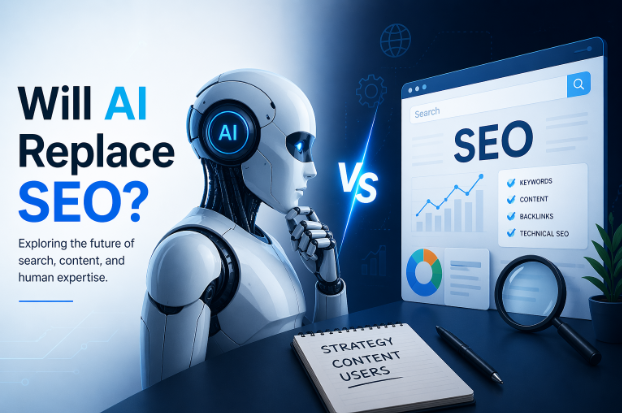
No, AI will not replace SEO. It is fundamentally changing how SEO works, shifting focus away from keyword-heavy pages toward expertise, structured content, and genuine authority. Businesses that adapt to AI search now will build an organic presence that compounds over time. Those that ignore the shift risk irrelevance.
Key Takeaways
What every business owner should carry from this:
- AI is not replacing SEO. It is changing what good SEO looks like and raising the quality bar significantly.
- Generic, AI-generated content published at scale is being actively deprioritised. Expert-led content with genuine depth is performing better than it has in years.
- Technical SEO, Schema markup, brand authority, and structured content are more important in 2026 than they were in 2022.
- Businesses integrating AI tools into their SEO workflows, not replacing strategy with them, are pulling measurably ahead.
- AI Overview citations come almost exclusively from pages that already rank well and are structured to be machine-readable.
- Branded search volume is the most defensible organic traffic a business can build, and it grows directly from consistent brand investment.
Every week, a new headline announces that AI has killed SEO. Every week, business owners lose sleep wondering if their website traffic is about to disappear.
The reality is more nuanced. The rules of the game have shifted, but the game itself is not going anywhere. What is dying is lazy SEO: thin content, keyword-stuffed pages, and generic blog posts written to game an algorithm rather than serve a reader. What is thriving is something far more valuable: real expertise, structured answers, and brands that have built genuine authority in their space.
This post breaks down exactly what AI is changing in SEO, what remains absolutely non-negotiable, and what your business should do right now to stay visible in an AI-driven search landscape. No hype, no vague reassurances. Just a clear picture of where search is heading and how to position yourself for it.
Why Everyone Is Asking About AI and SEO Right Now
The concern is understandable and well-founded. Google’s AI Overviews now appear at the top of millions of search results, synthesising answers directly from web content before a user clicks a single link. Tools like ChatGPT, Perplexity, and Claude are handling queries that would have sent people to Google a year ago. The search landscape has genuinely changed, and any business owner paying attention is right to ask what it means for their traffic.
| 65%
of Google searches end without a click in 2026, up from 58% in 2022 (SparkToro) |
500M+
weekly active users on ChatGPT as of Q1 2026 (OpenAI projections) |
8.5B+
searches processed by Google every single day in 2026 |
The Rise of AI Overviews and What They Mean for Traffic
Google’s AI Overviews pull answers from multiple high-authority sources and display them directly at the top of the page, above the traditional blue links. For queries that used to drive steady informational traffic, this has created a measurable dip in click-through rates for sites that relied on quick-answer content without the depth to warrant a citation.
What the data shows is important: AI Overviews do not replace the need to rank on Google. They pull almost exclusively from pages that already rank well, which means technical SEO, strong backlinks, and well-structured content remain the entry ticket. The difference is that appearing in an AI Overview requires your content to be structured in a way that an AI can parse, extract, and cite with confidence. That is a skill set most content teams are still developing.
The brands showing up in AI Overviews today are the ones that invested in depth, structure, and authority long before Overviews existed. They are reaping a compounding advantage.
How AI Writing Tools Are Changing the Content Playing Field
The other significant shift is on the supply side. AI content tools have made it trivially easy to produce articles at scale, and thousands of businesses are doing exactly that. The result is a dramatic increase in low-effort, generic content competing for the same search positions. Google’s response has been to double down hard on E-E-A-T: Experience, Expertise, Authoritativeness, and Trustworthiness.
In practical terms, Google is now far better at identifying and demoting content that lacks genuine insight, regardless of how well it is technically formatted. Original data, expert authorship, first-hand perspective, and brand authority are becoming the primary differentiators in competitive search verticals. That shift rewards businesses with real expertise and punishes those relying on content volume alone.
Which Traditional SEO Tactics Are Losing Their Effectiveness
Not everything in the old SEO playbook is obsolete, but some tactics that worked reliably in 2019 are producing diminishing returns in 2026. Understanding which ones to deprioritise frees up budget and attention for the strategies that genuinely move the needle.
- Keyword-stuffed content written purely to satisfy an algorithm, with no authentic angle or depth
- Thin 300-word blog posts targeting long-tail queries that AI Overviews now answer directly
- Backlink schemes built on private blog networks or paid placements on irrelevant sites
- Exact-match anchor text manipulation across large volumes of inbound links
- Duplicate or near-duplicate content spread across multiple pages to target variations of the same query
None of this means foundational SEO is broken. It means the bar for what constitutes good SEO has risen significantly, and the shortcuts that once worked are now counterproductive.
What AI Cannot Replace in SEO
The AI-replaces-SEO narrative falls apart when you look closely at what actually drives search visibility. There are core components of ranking and discoverability that no AI tool, regardless of how capable, can replicate on its own.
Human Expertise and Original Perspective
AI content tools are sophisticated synthesisers. They are excellent at recombining what already exists on the web. What they cannot do is produce a genuinely original insight, draw on lived professional experience, conduct primary research, or offer a perspective that does not already exist in their training data.
Google’s E-E-A-T framework specifically elevates the Experience dimension, meaning content that reflects first-hand knowledge from someone who has actually done the thing they are writing about. A cybersecurity consultant writing about a breach they managed, a financial adviser explaining a strategy they have implemented for clients, a contractor describing a structural issue they encountered on a real project: that is the kind of content AI cannot produce and that search engines are increasingly rewarding.
If your content includes original research, proprietary data, documented case studies, or expert commentary grounded in genuine practice, you have a structural advantage that does not erode as AI tools improve. That is the moat worth building.
Technical SEO and Site Infrastructure
Core Web Vitals, crawlability, structured data markup, mobile performance, internal linking architecture, site speed, and canonical tag management are not handled by an AI content generator. They require deliberate technical implementation and ongoing maintenance. A technically sound website is the foundation of any organic search strategy, and no amount of content quality compensates for a site that Google cannot crawl and understand efficiently.
Structured data has become particularly valuable in the AI search era. Pages that implement Schema markup for their content type, whether Article, FAQ, HowTo, Product, or LocalBusiness, give AI systems a structured signal to parse. Sites using Schema correctly are significantly more likely to have their content pulled into AI Overviews and featured snippets. This is a technical investment with a direct, measurable impact on AI search visibility.
Brand Authority and Long-Term Trust Signals
AI search engines do not surface anonymous sources. They pull from publishers and domains they have reason to trust, built up through consistent quality publishing, editorial mentions in reputable outlets, high-quality inbound links, positive engagement signals, and brand search volume. These signals take months and years to build, but once established, they create a compounding advantage that newcomers cannot shortcut.
Brand authority is the part of SEO that most resembles public relations work: earning recognition from credible sources over time, being cited in industry conversations, and showing up consistently enough that both search engines and readers associate your domain with reliability. This work is entirely human, strategic, and deeply difficult to replicate quickly.
WHAT AI IS CHANGING
|
WHAT AI CANNOT REPLACE
|
Will AI Replace SEO Professionals? The Role Is Evolving, Not Disappearing
The more useful question is whether SEO professionals who work intelligently with AI tools will outperform those who do not. The answer, based on what we are seeing in 2026, is unambiguously yes. The skill set is shifting, but the demand for strategic SEO expertise is not declining.
The Skills That Define Effective SEO in 2026
The combination of capabilities that drives results today looks quite different from the keyword-and-links formula that dominated a decade ago. Modern SEO requires a genuine blend of strategic, technical, and creative expertise.
- Content strategy and editorial judgement Understanding search intent at a granular level, meaning the ability to identify not just what people are searching for but why, and what type of content will satisfy that intent in a way a competitor has not yet addressed.
- AI Overview and featured snippet optimisation Structuring content so that AI systems can extract and cite it, using direct answers, clear headings, Schema markup, and logical information architecture.
- Technical SEO implementation Implementation of Schema markup, Core Web Vitals management, crawl budget optimisation, and internal linking strategy that distributes authority efficiently across the site.
- Authority building and digital PR Building the off-page signals that make a domain trustworthy: editorial mentions, genuine backlinks, brand search volume, and consistent presence in credible publications.
- Analytics-driven decision-making Making decisions based on what the data shows rather than what tactics were popular last year, including identifying traffic trends, intent shifts, and content gap opportunities before competitors do.
How Strong SEO Teams Are Using AI Tools
The best SEO practitioners are not replacing their work with AI. They are using AI to remove the low-value, time-consuming parts of the job so they can focus on the strategic work that produces compounding returns.
- Semantic keyword clustering and topic modelling across hundreds of search queries simultaneously
- Generating detailed content briefs and structural outlines that a subject-matter expert then fills with genuine insight
- Automated technical audits that identify crawl errors, duplicate content, and indexing issues at scale
- Testing meta title and description variations across large content libraries to improve click-through rates
- Identifying shifts in search intent and SERP format changes before they affect ranking positions
Used this way, AI tools multiply the output of a skilled SEO team. They do not replace the judgement, strategy, or expertise that determines whether any of that output actually performs.
The Businesses That Are Actually at Risk
The real danger in the current moment is not AI disrupting SEO as a discipline. The businesses at genuine risk are those that have misunderstood the shift and responded by publishing large volumes of unreviewed, AI-generated content in the hope that it will rank on volume alone. Google’s spam policies now explicitly target this type of content, and manual and algorithmic penalties for scaled content abuse have increased significantly through 2025 and into 2026.
A business that replaced its content team with a single AI tool subscription and a content calendar is building on sand. The moment Google’s systems flag that pattern, which they are becoming increasingly good at doing, the traffic disappears fast and recovers slowly.
| STRATEGIC INSIGHT
AI-generated content without a genuine editorial layer is a commodity. The moment content becomes a commodity in a given niche, it stops performing in search. Differentiation in voice, expertise, and original thinking is the most durable SEO asset any business can build in 2026. |
How to Adapt Your SEO Strategy for the AI Search Era
Adapting to AI-driven search does not require abandoning what has always worked. It requires evolving your approach around the specific signals that AI search systems reward, while doubling down on the fundamentals that were always the real drivers of long-term visibility.
Optimise Specifically for AI Overviews and Featured Snippets
AI Overviews pull from content that answers questions clearly, is structured logically, and comes from sources Google has established trust in. Improving your chances of being cited requires deliberate structural choices, not just good writing.
- Answer the core question directly within the first 50 to 60 words of the relevant section, before adding context or caveats
- Write H2 and H3 headings that mirror exactly how your target audience phrases their questions in search
- Implement FAQ Schema, Article Schema, and HowTo Schema where relevant so AI systems can parse your content structure programmatically
- Keep paragraphs short and focused on a single point. AI systems extract discrete answers, not long-form narrative passages
- Build topical authority by covering subjects comprehensively across multiple related pieces, not by writing one long article that touches many topics superficially
Topical authority, the state of being a genuinely comprehensive resource on a defined subject area, is one of the strongest signals AI search systems use to determine which sources are worth citing. Building it takes time, but the compounding effect on both traditional and AI search visibility is significant.
Build a Brand That People Search For Directly
Branded search is the most defensible form of organic traffic and the one most protected from AI disruption. When people search for your business by name, they have already made a decision. AI Overviews do not replace that intent; they cannot send someone searching for ‘Nine Mustangs digital agency’ to a competitor instead.
This is where brand strategy and SEO converge in ways that create a genuine competitive advantage. A business with strong brand recognition generates direct search volume, earns natural editorial mentions, attracts inbound links without active outreach, and builds the trust signals that AI systems use to determine which sources to cite. Investing in brand building is not separate from SEO strategy in 2026. It is central to it.
Create Content That AI Tools Cannot Produce
The most strategic content investment for any business right now is in formats that require genuine human input and institutional knowledge. These are the content types that AI cannot replicate and that search engines are actively prioritising.
- Original research and proprietary data: surveys, internal analytics insights, industry benchmarks collected from your own client work
- Expert interviews with credible practitioners who offer perspectives not available elsewhere online
- Case studies with specific, verifiable outcomes: real numbers, real timelines, real client contexts
- Editorial opinion and analysis pieces that take a clear, evidence-backed stance on a topic your audience cares about
- Comprehensive reference guides with enough depth that a reader does not need to look anywhere else
Each of these formats produces content that cannot be easily replicated by a competitor with an AI subscription and an afternoon. They build the kind of content library that earns editorial links, sustains traffic across algorithm updates, and compounds in authority over time.
Frequently Asked Questions
Q Will Google remove SEO ranking factors because of AI?
No. Google has publicly confirmed that core ranking signals, including relevance, content quality, and link authority, remain central to how search works. AI Overviews are layered on top of traditional rankings, not a replacement for them. The pages appearing in AI Overviews are almost always the same ones ranking in the top organic positions.
Q Is AI-generated content penalised by Google?
Google does not penalise content based on the tool used to produce it. Its guidelines focus on quality, helpfulness, and whether the content serves the reader. The issue is low-quality, unreviewed AI content published at scale with no editorial input. When AI is used to assist a skilled writer or subject-matter expert, the resulting content can perform very well in search.
Q How do I get my content to appear in Google’s AI Overviews?
Structure your content to answer questions directly in the first paragraph of each section. Use clear H2 and H3 headings that mirror how people phrase those questions in search. Implement structured data markup. Build topical authority through comprehensive coverage of your subject area. Earn quality backlinks from credible sources. AI Overviews prioritise sources with strong E-E-A-T signals.
Q How does AI search affect local SEO for small businesses?
Local SEO remains highly relevant because AI search tools serve geographically personalised results. A plumber in Manchester, a dentist in Karachi, or a restaurant in New York all benefit from Google Business Profile optimisation, local citations, and reviews in ways that AI Overviews do not disrupt. In fact, local queries with a purchase or visit intent are among the least affected by zero-click trends because the user action happens offline. Keeping your Google Business Profile accurate, collecting genuine reviews, and building local citations on authoritative directories remains essential.
Q How long does it realistically take for SEO to produce results?
For a new domain targeting competitive keywords, meaningful organic traffic typically takes 6 to 12 months to build. For an established site addressing content gaps in a niche with moderate competition, improvements can show within 8 to 12 weeks of publication. Technical SEO fixes, such as resolving crawl errors or improving Core Web Vitals, can produce faster results on sites that have existing authority. The consistent factor is that SEO is a compounding strategy: the work done today builds the foundation for results 6 months from now, and those results sustain themselves in ways paid advertising does not.
Q What is the difference between SEO and paid search advertising, and do I need both?
SEO builds organic visibility that does not stop the moment you stop paying. Paid search, typically Google Ads, delivers immediate visibility at a cost per click that is paid every time someone visits your site. The two strategies serve different business moments. Paid search is effective for time-sensitive campaigns, new product launches, or high-intent keywords where you need traffic now. SEO builds the long-term asset. For most businesses, using both together produces the strongest result: paid search delivers short-term conversions while SEO compounds into a traffic channel that eventually costs nothing per click.
Q How much should a business budget for SEO in 2026?
Budget ranges vary significantly by industry, competition level, and business size, but as a broad benchmark: small businesses in local or niche markets typically spend between $1,000 and $3,000 per month on SEO. Medium-sized businesses targeting regional or national keywords more commonly budget $3,000 to $8,000 per month. For competitive national or e-commerce verticals, monthly investment of $10,000 or more is common among serious players. The more important frame is return on investment. Organic traffic from well-executed SEO typically delivers a better cost-per-acquisition than paid channels over a 12-month horizon, which means budget allocated to SEO should be evaluated against that longer time frame rather than month-to-month.
| NINE MUSTANGS DIGITAL AGENCY
Your SEO Strategy Needs to Evolve. We Can Help. Most agencies are still running outdated playbooks in a 2026 search landscape. At Nine Mustangs, we build SEO and content strategies designed specifically for the AI search era, combining technical precision, brand authority, and expert-led content that gets cited, not buried. Get Your Free SEO Audit at ninemustangs.com SEO Strategy | Content Marketing | Brand Development | Web Design | Web Development |