
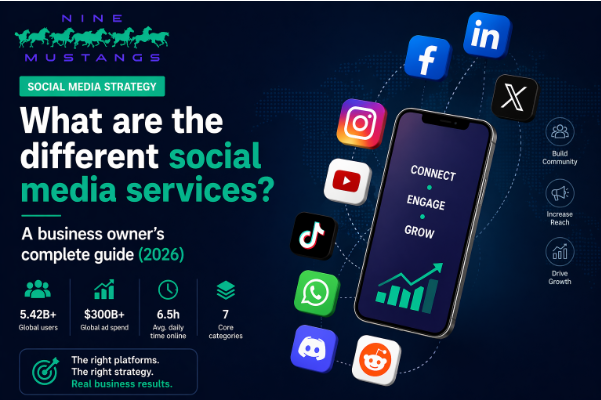
Social media services fall into seven core categories: social networking (Facebook, LinkedIn), visual content sharing (Instagram, YouTube), short-form video (TikTok), microblogging (X, Threads), private messaging (WhatsApp, Messenger), community forums (Reddit, Discord), and professional platforms. Each category serves a different audience behavior, and the right mix for your business depends on who you are trying to reach and what you want them to do.
Key takeaways
- There are seven core categories of social media service, and each one is built around a different type of audience behavior, content format, and business objective.
- LinkedIn generates four out of five B2B social media leads and offers some of the best organic reach remaining among major platforms, particularly for personal content from founders and executives.
- TikTok’s algorithm surfaces content based on engagement signals rather than follower count, giving newer brand accounts a genuine path to organic reach that Facebook and Instagram no longer provide.
- YouTube is the only major social platform whose content is directly indexed by Google, making it the highest long-term-value channel for businesses in research-intensive or considered-purchase categories.
- WhatsApp Business is a high-performing customer communication channel in markets outside North America and is frequently underused by brands with international audiences.
- Platform selection should start from audience behavior and business goals, not from what competitors are doing or what is generating coverage in the marketing press.
What are the different social media services?
Most business owners are already on social media. Very few are on the platforms that actually matter for their specific audience. The gap between those two groups is where most social media budgets quietly disappear.
As of early 2026, there are approximately 5.42 billion social media users globally, accounting for around 66% of the world’s population. Global ad spend across social platforms crossed $300 billion for the first time this year. The opportunity is real, but so is the noise. A business that understands the distinct purpose of each platform type has a structural advantage over competitors who post everywhere and measure nothing.
This guide covers every major category of social media service, what each platform is actually engineered to do, and a practical decision framework for choosing where your business should focus its time and budget in 2026.
Key Stats at a Glance
- 5.42 billion global social media users in 2026
- $300 billion+ in global social ad spend in 2026
- 7 core platform categories
- 6.5 hours average daily time online per user
What are the different social media services?
Social media is not a single channel. It is an ecosystem of platforms, each built around a different type of human behavior, content format, and audience expectation. Understanding these categories is the foundation of any strategy worth running.
Social networking platforms
These platforms are built around relationships. Users connect with people they know, communities they belong to, and brands they trust. For businesses, the value is not just reach but the ability to embed within existing social graphs where buying decisions get influenced.
With 3.35 billion monthly active users as of early 2026, Facebook remains the largest social network on earth. Its primary strength for businesses lies in hyper-targeted paid advertising, local business visibility, and community building through Groups. The organic reach of business pages has declined significantly over the past five years, which means Facebook now rewards businesses that invest in ads or build active group communities rather than those relying on page posts alone. For local service businesses, event-based businesses, and e-commerce brands, Facebook’s advertising infrastructure remains one of the most precise targeting tools available anywhere.
Best for: Paid ads, B2C, local business, Groups, Events
LinkedIn crossed 1.1 billion registered members in 2026, making it the definitive professional network globally. Unlike most platforms, LinkedIn’s organic reach is still relatively generous, particularly for personal profiles posting thought leadership content. Decision-makers, procurement managers, and C-suite executives are active users, making it the highest-ROI social platform for B2B companies by a wide margin. LinkedIn’s algorithm currently rewards content that generates conversation rather than content that simply gets views, which means posts that ask real questions or share genuine opinions consistently outperform polished promotional posts.
Best for: B2B, thought leadership, lead generation, recruitment
Visual content and content sharing platforms
These platforms center on media consumption. Photos, videos, and creative assets drive the experience, and discovery is largely algorithm-led. This means a brand with no existing audience can still reach large numbers of new, relevant users through consistent, quality content, unlike social networking platforms where reach depends heavily on who already follows you.
Instagram had approximately 2.4 billion monthly active users in early 2026. It functions as a brand’s visual portfolio and product discovery engine in one. Reels continue to dominate organic reach on the platform, with short-form video consistently generating two to three times more impressions than static posts for the same account. Instagram Shopping has become a significant revenue channel for e-commerce brands, allowing users to move from discovery to purchase without leaving the app. For any business where the product or service has a visual dimension, Instagram remains one of the most cost-effective channels for building brand recognition organically.
Best for: Visual branding, e-commerce, Reels, influencer partnerships
YouTube
YouTube’s 2.7 billion monthly active users make it the world’s second-largest search engine after Google, which is itself a YouTube property. This is the most important distinction of any platform in this guide: YouTube content is indexed by Google and surfaces in standard search results. A well-optimised tutorial, product review, or explainer video can generate qualified traffic for years after it is published, unlike content on every other social platform which has an effective lifespan measured in hours or days. For businesses in complex or considered-purchase categories, where buyers research extensively before buying, a YouTube content library is a long-term asset with compounding returns.
Best for: SEO value, long-form content, tutorials, search intent traffic
Pinterest reached approximately 540 million monthly active users in 2026. Its demographic skews heavily toward women between 25 and 54, and its behavioral profile is unique among social platforms: users arrive actively searching for inspiration and ideas, rather than passively scrolling. This intent-driven context produces higher purchase conversion rates compared to platforms where audiences are in a passive consumption mode. Pinterest content also has a notably long shelf life, with pins continuing to generate clicks months or even years after posting. For lifestyle, food, home design, fashion, and wedding-adjacent businesses, Pinterest frequently outperforms channels with far larger user bases.
Best for: High-intent discovery, e-commerce, long content shelf life
Short-form video platforms
Short-form vertical video has fundamentally changed how audiences consume branded content. The format favors authenticity over production quality, speed over depth, and entertainment over information. Brands that adapted early have built substantial audiences with minimal ad spend.
TikTok
TikTok had approximately 1.8 billion monthly active users globally in early 2026, operating across more than 150 countries. Its algorithm is structurally different from every other major platform in one critical way: content is shown based on engagement signals, not follower count. A business account with zero followers and a genuinely compelling video can reach millions of users. Average engagement rates on TikTok sit between 4% and 7%, which is three to five times higher than Instagram’s average. The platform’s core audience remains 18 to 34, but usage among the 35 to 54 bracket grew substantially through 2024 and 2025. For any business with a product or service that can be demonstrated, explained, or made entertaining in under 60 seconds, TikTok offers exceptional organic reach at a time when organic reach on most other platforms is shrinking.
Best for: Organic reach, Gen Z, high engagement, viral potential
Worth knowing: YouTube Shorts and Instagram Reels serve a parallel purpose to TikTok and reach overlapping audiences. The practical advantage of creating short-form video for these companion formats is that the same content can be distributed across all three platforms simultaneously, multiplying reach without multiplying production time.
Microblogging and real-time platforms
Real-time platforms are built for speed and conversation. They are where news spreads, opinions form, and industries debate. Brands that engage here authentically build authority and relevance in ways that polished, scheduled content on other platforms simply cannot replicate.
X (formerly Twitter)
X reported approximately 600 million monthly active users heading into 2026. Despite years of turbulence following the rebranding and ownership change, X remains the primary platform for real-time commentary across technology, finance, media, sports, and politics. For business owners and executives, X functions best as a personal brand-building tool rather than a brand channel. Founders who share genuine opinions, industry takes, and behind-the-scenes context consistently outperform corporate accounts that post promotional content. X Premium, which provides account verification and algorithmic amplification, has become a near-requirement for accounts serious about reach. The platform’s open, searchable nature also makes it valuable for social listening: monitoring what customers, competitors, and industry figures are saying about relevant topics.
Threads
Meta’s Threads platform surpassed 350 million monthly active users by early 2026. Built as a text-first complement to Instagram and distributed to users through their existing Instagram audiences, Threads has attracted a notably different content culture from X: slightly more conversational, less combative, and more community-oriented. For brands already established on Instagram, Threads offers an extension into text-based engagement with relatively low competitive pressure. The platform’s algorithm is still maturing, which historically means better organic reach for early consistent posters before the feed gets crowded.
Bluesky
Bluesky, the decentralised microblogging platform, grew to over 30 million users by late 2025 and continues to attract journalists, academics, researchers, and tech professionals who migrated away from X. It does not yet represent a meaningful marketing channel for most businesses, but for brands whose audience is concentrated in media, academia, or technology, building an early presence costs very little and positions the brand ahead of potential mainstream growth.
Professional and B2B social media services
B2B companies consistently underinvest in the platforms where their buyers actually spend time. Understanding the professional social media ecosystem closes that gap.
LinkedIn as a lead generation engine
Four out of five B2B leads from social media originate on LinkedIn, according to LinkedIn’s own published data, and this figure has held consistently across multiple years. Beyond raw lead volume, the quality of LinkedIn leads is distinct because users are in a professional mindset while browsing. A company page posting consistently, covering topics relevant to their buyers’ actual challenges, generates inbound enquiries from people who are already a reasonable fit. LinkedIn Newsletters have seen open rates between 35% and 60% in practice, a figure that dwarfs typical email marketing benchmarks of 20 to 25%. LinkedIn’s paid advertising tools allow targeting by job title, seniority, company size, industry, and specific companies by name, making it the most precise B2B targeting tool in social media.
- Company pages that post consistently see significantly more impressions than those posting sporadically
- Employee advocacy, where team members share company content from personal accounts, regularly outperforms the same content posted from the brand page
- LinkedIn Live and audio events give brands direct access to engaged professional audiences with lower setup requirements than a podcast or webinar
- Sponsored Message Ads have some of the highest open rates in digital advertising when the targeting is precise
Slack communities and niche professional networks
For SaaS companies, consultancies, and technology brands, Slack communities function as professional social networks with highly concentrated, relevant audiences. Industry-specific Slack workspaces often host hundreds to thousands of decision-makers discussing their exact problems. Genuine participation, sharing useful resources, and answering questions builds brand recognition and trust with audiences that are almost impossible to reach through conventional advertising. This approach requires patience and a commitment to providing real value without overt promotion, but the relationships it builds tend to convert at rates far higher than cold outreach.
Niche and industry-specific platforms
Depending on the sector, specialist platforms can be more valuable than any mainstream social network. Behance and Dribbble serve the design and creative industry. Houzz connects home improvement and interior design businesses with active homeowners. ResearchGate matters for brands selling to academic or scientific audiences. Alignable is a small business networking platform with strong local engagement in North America. The common thread across all of these is concentration: a smaller total audience, but a far higher proportion of people who are directly relevant to the business.
Discussion and community-based platforms
Some of the most valuable brand interactions happen not in broadcast channels but inside communities where people ask real questions and share unfiltered opinions. These platforms reward contribution over promotion.
Reddit had over 100 million daily active users in early 2026, distributed across more than 100,000 topic-specific communities called subreddits. Reddit audiences are famously skeptical of marketing, and promotional content is frequently called out, downvoted, or removed by community moderators. However, this same culture makes authentic participation unusually powerful. A brand representative who shows up consistently in a relevant subreddit, answers questions honestly, shares useful resources, and never oversells, builds genuine credibility and brand preference over time. Reddit content also has strong search engine visibility: threads appear in Google results with notable frequency, which means positive brand mentions in relevant subreddits contribute to a business’s long-tail search presence without any direct SEO effort.
Discord
Discord’s approximately 200 million monthly active users skew toward gaming, technology, crypto, music, and creative communities. The platform’s server structure allows brands to build owned communities where members can engage across different topic channels, access exclusive content, and interact directly with the brand team. Discord communities, when managed well, produce some of the highest levels of brand loyalty and word-of-mouth of any social channel. The tradeoff is that building and moderating a Discord server requires sustained effort and a community management strategy, not just content scheduling.
Quora
Quora attracts over 400 million monthly visitors, many of them arriving directly from Google searches. Users ask specific questions and vote up the most useful answers, creating a meritocratic knowledge environment. For businesses with genuine expertise in a domain, answering relevant questions on Quora is a credibility-building exercise that also generates lasting referral traffic. Well-written answers from recognisable brand accounts or named experts routinely appear in search results for the questions they address, extending the content’s useful life far beyond the platform itself.
Messaging and private social media services
A growing share of online conversation happens in private channels that standard analytics tools cannot track. This so-called dark social traffic, content shared through messaging apps rather than public posts, accounts for a substantial proportion of referral traffic for many businesses, making messaging platforms an increasingly important consideration for serious social media strategies.
WhatsApp Business
WhatsApp reached approximately 2.9 billion monthly active users in early 2026, making it the world’s most widely used messaging application. WhatsApp Business allows companies to create a verified business profile with a product or service catalog, set up automated greeting and away messages, organise contacts with labels, and build broadcast lists for direct customer outreach. In South Asia, the Middle East, Latin America, and significant parts of Europe and Africa, WhatsApp functions as the primary channel for customer service communication and often replaces email entirely. For businesses operating in or selling to these markets, not having a WhatsApp Business presence is a meaningful competitive disadvantage.
Facebook Messenger
Messenger has approximately 930 million active users and remains the dominant messaging platform in markets where Facebook penetration is high. Messenger chatbots, when configured thoughtfully, deliver open rates above 80%, compared to the 20 to 25% industry average for email marketing. This makes Messenger a high-performance channel for post-purchase follow-up, order updates, promotional announcements, and abandoned cart recovery for e-commerce businesses. The key limitation is that users must initiate contact first, or give explicit permission to receive messages, before a business can message them proactively.
Snapchat
Snapchat had approximately 460 million daily active users in early 2026, with particularly strong penetration in the 13 to 34 age group across North America, Europe, and the Middle East. The platform’s ephemeral content format, augmented reality filters, and Snap Map features make it well-suited to brands targeting younger consumer segments with campaign-style content rather than always-on brand storytelling. Snapchat’s AR advertising tools, which allow users to try on products or interact with branded experiences through the camera, are among the most immersive ad formats available across any platform.
How to choose the right social media services for your business
Committing to fewer platforms and executing well on each produces better results than spreading effort thinly across many. The decision should be driven by audience behavior, content capacity, and business goals, in that order.
Start with where your audience already is
Customer research matters more here than platform statistics. The most popular platform globally is irrelevant if your specific buyers are not active there. Review where your existing customers mention finding you. Look at which platforms drive referral traffic in your analytics. If you sell to other businesses, LinkedIn and YouTube deserve serious investment before anywhere else. If your product is purchased by 18 to 35 year olds based on visual appeal or social proof, Instagram and TikTok are the natural priority.
Platform Selection Guide by Audience Type
| Audience Profile | Primary Platform | Strong Secondary |
| B2B / corporate decision-makers | YouTube, X | |
| Gen Z and young consumers (18 to 34) | TikTok | Instagram, Snapchat |
| Visual and lifestyle brands | Pinterest, YouTube | |
| Local and service businesses | Instagram, WhatsApp | |
| Tech and SaaS companies | X, Reddit, YouTube | |
| E-commerce and direct-to-consumer brands | TikTok, Pinterest |
Match content format to platform expectations
Publishing the wrong content format on the right platform still underperforms. Each platform trains its users to expect specific content types, and content that does not match those expectations gets scrolled past regardless of quality. A detailed written analysis that would perform well on LinkedIn would get no engagement on TikTok. A 60-second product demo that drives conversions on TikTok would look out of place on Pinterest. Understanding format expectations before committing time to production saves considerable wasted effort.
- Long-form educational and thought leadership content works on YouTube, LinkedIn Articles, and newsletters
- Short-form vertical video under 90 seconds performs on TikTok, Instagram Reels, and YouTube Shorts
- Static product imagery and inspiration boards suit Instagram and Pinterest
- Real-time opinions, industry commentary, and conversation belong on X and Threads
- Community building and discussion-led engagement belongs on Reddit, Discord, and Facebook Groups
- Direct customer communication and transactional messaging works best through WhatsApp Business and Messenger
Define your goals before selecting platforms
Social media goals are not all equivalent, and the same platform can serve different goals with very different results. A business using Instagram for brand awareness needs a completely different content approach from one using Instagram for direct product sales. Being specific about the goal before choosing platforms avoids the common mistake of measuring the wrong things and drawing incorrect conclusions about whether a platform is working.
- Brand awareness and reach: TikTok, Instagram, YouTube Shorts
- Lead generation and pipeline: LinkedIn, YouTube, Facebook ads
- Customer retention and loyalty: WhatsApp, Facebook Groups, Discord
- Thought leadership and category authority: LinkedIn, X, YouTube
- Organic search traffic: YouTube, Pinterest, Reddit, Quora
- Direct sales and e-commerce conversion: Instagram Shopping, TikTok Shop, Pinterest
Final Thoughts
The brands that get the most consistent results from social media are rarely the ones with the largest content output. They are the ones who picked two or three platforms deliberately, understood exactly what their audience was looking for in each context, and built a repeatable system for showing up there with relevant content. A social media audit that maps your customer journey to specific platform touchpoints is almost always the highest-value starting point before committing budget anywhere.
Frequently asked questions
How often should a business post on social media?
Posting frequency matters less than posting consistently. A realistic schedule you can maintain is more valuable than an aggressive schedule you cannot. As a practical benchmark: LinkedIn rewards quality over quantity, with two to four posts per week from personal profiles performing better than daily posting for most accounts. Instagram and Facebook pages benefit from three to five posts per week, supplemented by daily Stories if capacity allows. TikTok’s algorithm responds well to higher frequency, with three to five videos per week being a common starting point for accounts building an audience. The most important rule across every platform is to stop posting when you have nothing worth saying. Filler content actively reduces audience trust and algorithmic distribution over time.
How do social media algorithms decide what content gets shown?
Each platform uses its own algorithm, but most share a similar foundational logic: content that generates fast, strong engagement signals gets shown to more people, while content that gets ignored gets suppressed. LinkedIn prioritises content that generates meaningful comments within the first hour. Instagram’s Reels algorithm weighs watch-through rate heavily, meaning videos that hold attention from start to finish outperform those that cause viewers to scroll away early. TikTok distributes content to small test groups first, then amplifies based on completion rate and shares. Facebook deprioritises link posts that take users off the platform and rewards native content. Knowing the specific engagement signal a platform values most allows you to optimise your content format and structure accordingly.
What is the difference between organic social media and paid social advertising?
Organic social media refers to content you publish without paying to promote it. Its reach depends entirely on your existing followers and whatever the platform’s algorithm decides to distribute to non-followers. Paid social advertising involves paying a platform to show your content to a defined audience, regardless of whether they follow your account. The practical difference for businesses is this: organic content builds long-term brand equity, community, and trust, but reaches a limited and declining percentage of your existing audience on most platforms. Paid advertising reaches precisely targeted new audiences immediately but stops the moment the budget stops. The strongest social media strategies treat these as complementary rather than competing investments. Organic content builds the credibility that makes your ads more effective, and paid distribution amplifies the organic content that is already proving itself with your existing audience.
How do you measure the ROI of social media marketing?
Measuring social media ROI requires connecting platform activity to business outcomes, not just platform metrics. Vanity metrics like follower counts and post impressions have their place in tracking brand awareness, but they do not tell you whether social media is contributing to revenue. The measurement framework depends on your goal. For lead generation, track website sessions from social referrals, form completions attributed to social traffic, and the cost per lead from paid campaigns. For e-commerce, track add-to-cart and purchase events through platform pixels. For brand awareness, track direct traffic growth, branded search volume, and share-of-voice over time. Setting up UTM parameters on all links shared through social channels is the minimum requirement for attributing web traffic correctly.
Can a business reuse the same content across multiple social media platforms?
Yes, with adaptation. Direct cross-posting of identical content without adjusting format, caption style, or aspect ratio is noticeable to audiences and tends to underperform on every platform it is posted to. Effective content repurposing works differently: a single core idea is produced once and then reformatted to match each platform’s native content expectations. A long-form YouTube video becomes a series of short LinkedIn posts drawing out individual insights. A well-performing TikTok gets uploaded as an Instagram Reel and a YouTube Short. A detailed blog post becomes the script for a YouTube video, then gets broken into a Threads thread. The rule is to adapt format and context for each platform, while the underlying insight or idea remains consistent across all of them.